

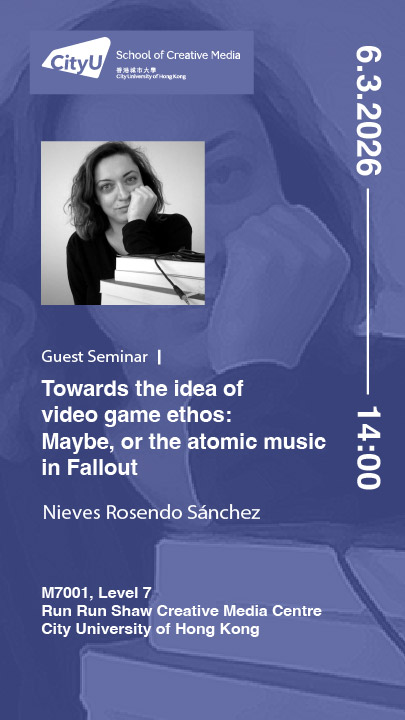
Towards the idea of video game ethos: Maybe, or the atomic music in Fallout
Seminar
06 Mar 2026
2:00 pm - 3:00 pm
M7001, L7, Run Run Shaw Creative Media Centre, City University of Hong Kong
Free admission.
|
|
Registration deadline: 5 March 2026 (Friday) 17:00
Registration link: https://forms.gle/887FS5QYpVD2eFNb6
Abstract
One of the foundational milestones in the musical construction of the Fallout universe was the choice of "Maybe" by The Ink Spots as the main theme for the first game. This decision prevailed over the option initially considered by one of its creators, Brian Fargo: "Warriors of the Wasteland" (1986) by Frankie Goes to Hollywood. The latter, with its epic and dystopian tone, drew directly on Mad Max 2 but was discarded in favor of a more ironic and nostalgic aesthetic that has persisted throughout the entire saga: the popular music reflecting the so-called Atomic Age (Boyer, 1985). Since its initial release in 1997, the Fallout franchise has established a unique narrative universe in video games, characterized by a retrofuturistic aesthetic and an ironic critique of technological progress.
Starting with Fallout 3 (2008), diegetic popular music became a key resource through the game's radio stations. Songs from the 1930s to the 1960s accompany the player's experience, combining a playful function with the ironic effect created by contrasting them with the desolation of the game's post-apocalyptic present. This music, far from being a mere aesthetic element, is integrated into the gameplay as a structural part of the franchise's ironic and nostalgic expressive system (Cheng, 2014; Ivănescu, 2019).
This lecture examines how this distinctive, playful, and aesthetic element of Fallout has been successfully adapted in the eponymous television series (Amazon Prime, 2024-). Through a mixed quantitative and qualitative analysis of the musical repertoire used in the series, it explores how the selection and staging of the songs preserve the playful and ironic character of the original work. The objective is to demonstrate how the music contributes to articulating what we can establish as the ethos of the Fallout Universe: a combination of dark humor, intertextuality, and social critique that permeates the different media in which it is presented within the Fallout Universe's fictional and transmedia world.
However, this successful process of adaptation leads us to a more profound reflection that constitutes the core of the second part of this lecture: ontologically speaking, the ethos can’t be only the aesthetic layer of the video game; it has to be part of its mechanics.
So, what is a video game ethos, then? How can it be designed for non-interactive media? Are some ethos so tied to the interactive nature of the medium that their transmedialization proves impossible, inevitably leading to a superficial representation of their key features ? The adaptation of Fallout thus stands as an interesting case study for interrogating the limits and possibilities of video games' very identity in the age of media convergence.
About the Speaker
Nieves Rosendo Sánchez is an Assistant Professor at the University of Granada, where she teaches and researches in the fields of transmedial narratives, adaptation studies, and digital culture, at the Department of Literary Theory. She holds a PhD in Communication, awarded cum laude with an International Mention, for her dissertation on transmedial narratives—a line of inquiry she has pursued since her Master's thesis on narratology and new media, which received the highest distinction.
Her research focuses on intermediality and the migration of narratives, fictional worlds, and characters across different media, with a particular emphasis on video games and digital storytelling. She has been an integral member of three consecutive national I+D+i research projects on transmediality, through which she has collaborated with leading figures in the field. Her work on ludofictional worlds, transmedia characters, and the boundaries between fiction and non-fiction has been published in high-impact journals such as Narrative, Brumal, Artnodes, and Pasavento, and she has been cited by prominent scholars including Jan Baetens, Jan-Noel Thon and Joleen Blom.
Special Arrangement
Non-CityUHK visitors are welcome to attend the seminar. Please register at https://forms.gle/887FS5QYpVD2eFNb6 by 5 March 2026 17:00
Please note:
1. All visitors who are not CityUHK members and who wish to enter the University campus must pre-register via the University's Visitor Registration System (VRS).
2. Visitors to CMC will not have access to other campus areas beyond the seminar venue on the day of the event.