

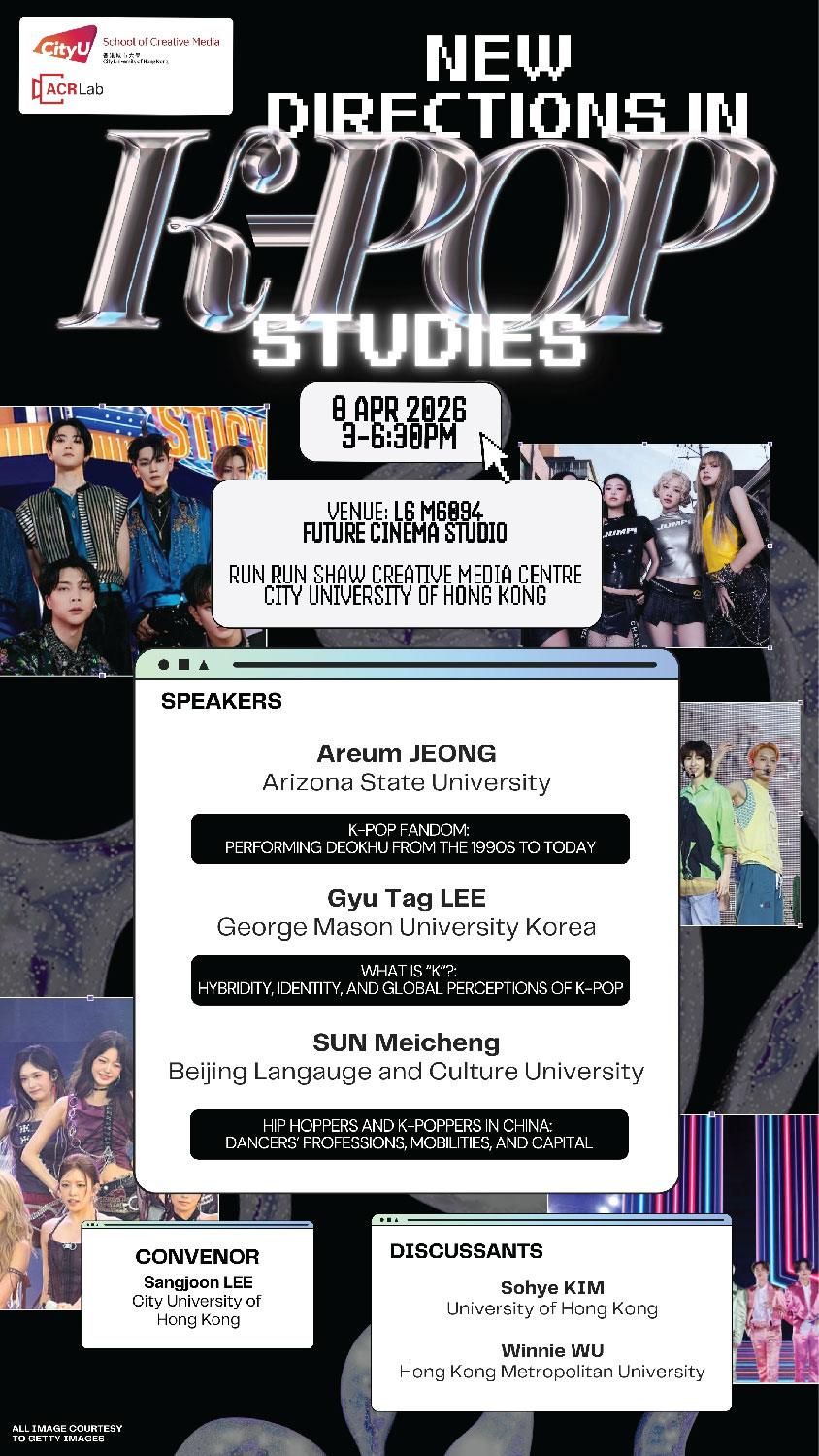
New Directions in K-Pop Studies
Symposium
K-Pop (or Korean pop) is no longer just a Korean music genre. It is a global cultural force. Blending pop, hip-hop, electronic, and traditional Korean elements, it has transcended sound to become a sophisticated media and social phenomenon. This symposium brings together three leading international scholars to discuss K-Pop’s rise as a cultural-industrial system. We will explore the engine of its global reach, examining its role within digital capitalism, shifting geopolitics, and emerging socio-political movements. Join us to deepen your understanding of this cultural force at the convergence of music, media, and global studies.
08 Apr 2026
15:00 – 18:30
Future Cinema Studio (M6094), L6, Run Run Shaw Creative Media Centre, City University of Hong Kong.
Free admission
|
|
This symposium will be held on-site in person.
The language of discussion will be English only.
Place is limited.
Registration deadline: 3 April 2026 (Friday)
Registration link: https://forms.gle/AigTdjvVzwHw5iJN9
Registration IS NOT REQUIRED for City University students and staff.
Convenor:
Sangjoon LEE
Associate Professor of Asian Cinema
School of Creative Media, City University of Hong Kong
For further inquiries, please email: arielhm.chan@cityu.edu.hk
Symposium Schedule
3:00 – 5:00 PM
Panel 1: New Directions in K-Pop Studies
Chair: Sangjoon Lee (City University of Hong Kong)
“K-Pop Fandom: Performing Deokhu from the 1990s to Today”
Areum JEONG (Arizona State University)
“What Is “K”?: Hybridity, Identity, and Global Perceptions of K-Pop”
Gyu-tag LEE (George Mason University Korea)
“Hip Hoppers and K-Poppers in China: Dancers’ Professions, Mobilities, and Capital”
Meicheng SUN (Beijing Language and Culture University)
Discussants:
Sohye KIM
University of Hong Kong
Winnie Yanjing WU
Hong Kong Metropolitan University
5:20 – 6:30 PM
Roundtable Discussion: Future Directions of K-pop Studies
With Sangjoon Lee, Areum Jeong, Gyu-tag Lee, and Meiching Sun
Abstracts
K-Pop Fandom: Performing Deokhu from the 1990s to Today
Fan practices have been central to K-pop’s production as an artistic and cultural phenomenon and behemoth global industry. And yet, even as fans have by now been widely recognized as important to the spectacular phenomenon that is K-pop, we are far from a systematic understanding of fan practices as labor practices—that is, as work that produces value and without which K-pop as we know it would not exist. Based on my book, K-Pop Fandom: Performing Deokhu from the 1990s to Today, this talk examines how fan practices constitute a central productive force, shaping not only K-pop’s explosive global popularity but also K-pop’s cultural and social impacts, cultural politics, and horizons of possibility. In particular, I argue that K-pop fans, in performing deokhu—a Korean term connoting an “avid fan”—perform a kind of materialization of affective labor. This materialization of affective labor takes place across diverse fandom arenas and processes, from generalized, collective, and communal fan activities to decentralized, personalized labor that represents individual fans’ personalities and performances of care. To conduct this study, I combine insights from ethnography, cultural studies, fan studies, media studies, and performance studies. Significantly, I also draw on my own research as a participant-observer and co-performer witness.
Areum JEONG is an interdisciplinary scholar and educator of Korean and Korean diasporic cinema, literature, popular culture, theatre and performance. She is currently an Assistant Professor of Korean Studies at Arizona State University. She is the author of Beyond the Sewol: Activist Theatre and Performance in South Korea and Diaspora (University of Hawaii Press, September 2025) and K-Pop Fandom: Performing Deokhu from the 1990s to Today (University of Michigan Press, February 2026).
What Is “K”?: Hybridity, Identity, and Global Perceptions of K-Pop
This talk explains how the meaning and boundaries of K-pop are constituted through the interplay of musical hybridity, industrial structure, and audience recognition. Moving beyond descriptive accounts of K-pop’s global success, it proposes a comparative and theoretically grounded framework that situates K-pop within the broader landscape of global popular music. Through analyses of its relationship with Swedish pop, Latin pop, and world music, this talk shows that K-pop is neither defined by fixed musical or linguistic features nor confined to Korean ethnicity or geography. Instead, its distinctiveness lies in a business model—an integrated “agency–idol system” based on “total management strategy” that combines long-term training, synchronized choreography, audiovisual storytelling, and coordinated multimedia rollouts. While this model anchors K-pop’s Korean provenance, it simultaneously enables transnational adaptability. This talk further explores how the “K” functions as a polyvalent signifier: a marker of national authorship for domestic audiences, a symbol of cosmopolitan modernity for global fans, and a representation of cultural visibility for diasporic communities. By reframing K-pop as both a cultural product and an institutional practice, this talk concludes K-pop as the cultural phenomenon showing hybridity, globalization, and cultural identity in popular music.
Gyu Tag LEE is a Professor of Global Affairs and the Director of Center for Korean Culture and Society at George Mason University Korea. His main research fields are popular music, critical media studies, globalization of culture, and especially, K-Pop and Hallyu. He has been writing books and articles about K-Pop, popular music and Hallyu including <The K-Pop Age 케이팝의 시대> (2016), <K-Pop in Conflict 갈등하는 케이, 팝> (2020), <Z With Luv: Post-BTS and the Future of K-Pop Z를 위한 시> (2023), and a co-written book <Exploring Hallyu 한류 탐색> (2024) (all in Korean).
Hip Hoppers and K-Poppers in China: Dancers’ Professions, Mobilities, and Capital
As one of the key elements of hip-hop culture, hip hop dance (also known as street dance) entered China in the 1980s. A decade later, K-pop dance, as a key element of K-pop, started to be popular among Chinese youngsters in the 1990s. In the 2020s, with the increasing demand for learning the two genres, teaching popular dance has become a potential career for Chinese youths. Drawing on Bourdieu’s (1986) theory of capital, employing geographical, virtual, and social mobilities as an analytical framework, and using in-depth interview data, this article compares how the locally mixed professional hip hop dancers (also known as street dancers) and professional K-pop dancers in China accumulate their capital through popular dance professions. This research shows that they accumulate capital differently, as the street dancers adhere to the student-to-teacher trajectory while the K-pop dancers follow the ordinary person-to-celebrity path in their career development. The differences between the seemingly similar dancers of the two genres are possibly due to the different cultural traditions of hip hop and K-pop. Cultural traditions and cultural trends play important roles in professional dancers’ mobilities and capital accumulation. This research explores how the forms of capital can be applied to explain the contemporary creative labor in China, as well as global popular culture’s local development in China after the country’s reform and opening up.
Meicheng SUN received her PhD degree in Communication Studies from Nanyang Technological University, Singapore, in 2022. Her dissertation is titled From H.O.T. to GOT7: Mapping K pop's Fandom, Media, and Performances in China. Currently, she is an Assistant Professor at Beijing Language and Culture University. Her research interests include transnational popular cultural flows and creative industries in East Asia. She has been publishing her research on K-pop in China. Her paper “Mobile Media and Chinese K-Pop Fandom” was recently published in the edited volume Mobile Media Use Among Children and Youth in Asia by Springer.
VISITOR ARRANGEMENTS
1. All visitors entering the University campus must be pre-registered via the University's Visitor Registration System (VRS). The VRS can be accessed via Office Admin under AIMS by departmental staff who have VRS access privileges.
2. Once the visitor's information has been submitted via the VRS, an email will be sent to the visitor with a special QR code attached from the CityUHK-Visitor Registration System. The visitor must show the QR code and may need to present his/her personal ID to the security staff at campus entrance on the day of the visit. Upon confirmation, the visitor will receive a label valid for the day.
3. For guests who didn't receive the above email with the QR code, please check your spam or junk email folder in case the email was accidentally marked as spam.
4. A single email address cannot be shared with multiple visitors for registration on the same day.
5. Please refer to the Personal Information Collection Statement (PICS) for Visitor Registration System on our university's website: https://www.cityu.edu.hk/fmo/download/Personal%20Information%20Collection%20Statement_VRS.pdf
6. If you are CityUHK member, please use your staff or student card to access the campus. You do not need to register for the VRS.
7. The Organizer/Presenter reserves the right to change, suspend or cancel the Event and Campus Access Policy or amend its terms and conditions at its discretion and to refuse entry to any person without prior notice.
General Enquiry
arielhm.chan@cityu.edu.hk Asian Cinema Research Lab (ACR Lab)