

8th SCM Research Colloquium 2025/26
Seminar
The SCM Research Colloquium serves as a presentation platform for sharing and discussing recent projects within SCM, featuring presentations by researchers, faculty members, and esteemed guests. As a session open to all for ideas exchange and intellectual conversations, each session features two speakers, accompanied by engaging Q&A discussions hosted by either Prof. Espen Aarseth or Prof. Richard Allen.
21 Apr 2026
3:30 pm - 5:30 pm
Screening Room 2 (M6058), Run Run Shaw Creative Media Centre
Free Admission
|
|
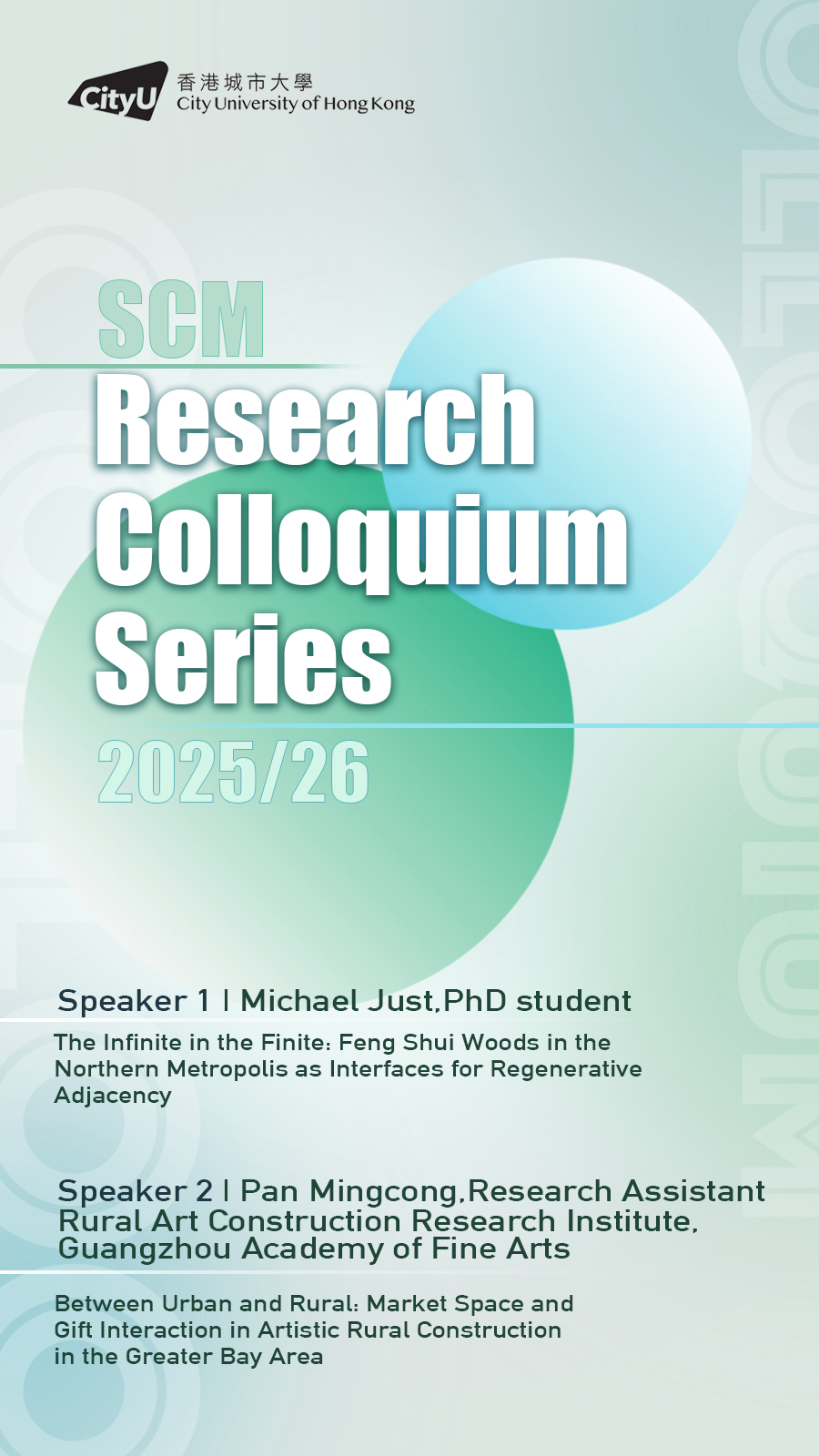
In this session, we are excited to welcome SCM PhD student, Michael Just, and Research Assistant, Pan Mingcong, from the Rural Art Construction Research Institute, Guangzhou Academy of Fine Arts to share their research projects.
Seminar 8
21 April 2026 (Tuesday), 3:30 pm - 5:30 pm
The Infinite in the Finite: Feng Shui Woods in the Northern Metropolis as Interfaces for Regenerative Adjacency
Michael Just, PhD student
Based on the last chapter of my PhD thesis, his presentation examines the Feng Shui woods of Ho Sheung Heung and the San Tin and Lok Ma Chau areas, positioned at the contested urban and rural seams of Hong Kong’s Northern Metropolis. With over 3,000 hectares slated for development, traditional ecological and cultural landscapes are frequently framed as passive heritage requiring static protection. Taking a process-relational approach, this research reconceptualizes these sites as active zones of spatial friction. Drawing on film-based fieldwork in Guangdong villages, the presentation deploys the Lingnan garden principle of enfolding the infinite in the finite to frame the Feng Shui woods as dynamic, machinic interfaces. These localized ecologies compress expansive ancestral memory and kinship practices into specific site constraints, establishing an active node to negotiate with the encroaching urban development. The research argues that preservation does not imply invariance but is a processual generative dynamic of mutual modulation between diverse embodiments and diverse minds. The presentation concludes that regenerative adjacency is enacted by designing for continuous environmental coupling. Within this framework, ancestrality operates as a set of enabling constraints that actively re-pair historical practices with a shifting, more-than-human urban ecology.
Between Urban and Rural: Market Space and Gift Interaction in Artistic Rural Construction in the Greater Bay Area
Pan Mingcong, Research Assistant, the Rural Art Construction Research Institute, Guangzhou Academy of Fine Arts
Against the imbalance of urban-rural development in the Guangdong-Hong Kong-Macao Greater Bay Area, "artistic rural construction" has become a crucial approach to connect urban and rural areas and reshape rural values. Taking Tangkou Town in Kaiping, Zhouqian Village in Shaoguan, Gulang Village in Shunde and Ho Sheung Heung, the New Territories of Hong Kong as cases, this study focuses on rural market spaces and gift interactions to explore the practical mechanism of art intervention in rural areas. The traditional urban-rural dualism has severed rural culture and social bonds, while rural markets, as core spaces for urban-rural interaction, integrate commodity exchange, cultural communication and emotional maintenance. Based on Marcel Mauss’ s gift exchange theory, urban and rural areas achieve a reciprocal cycle of "giving-receiving-returning" through local specialties, artworks and public activities, rebuilding cultural identity. The three sites activate local culture by renovating old buildings, holding art exhibitions and organizing market activities. Ho Sheung Heung, the New Territories of Hong Kong face challenges of globalization and planned development, requiring interdisciplinary collaboration and cultural reconstruction for sustainable development. Meanwhile, this study reflects on issues such as rural gentrification and the impact of commercial capital, proposing that artistic rural construction should root in rural context, take rural markets as a link, build an open, local and sustainable urban-rural integration space, and balance economic development and cultural inheritance.
We highly recommend PhD and Master's students and faculty members to join the informative and inspiring academic seminar to gain creativity and opportunities. We are looking forward to seeing you at our research colloquium.