

6th SCM Research Colloquium 2025/26
Seminar
The SCM Research Colloquium serves as a presentation platform for sharing and discussing recent projects within SCM, featuring presentations by researchers, faculty members, and esteemed guests. As a session open to all for ideas exchange and intellectual conversations, each session features two speakers, accompanied by engaging Q&A discussions hosted by either Prof. Espen Aarseth or Prof. Richard Allen.
17 Mar 2026
3:30 pm - 5:30 pm
Screening Room 2 (M6058), Run Run Shaw Creative Media Centre
Free Admission
|
|
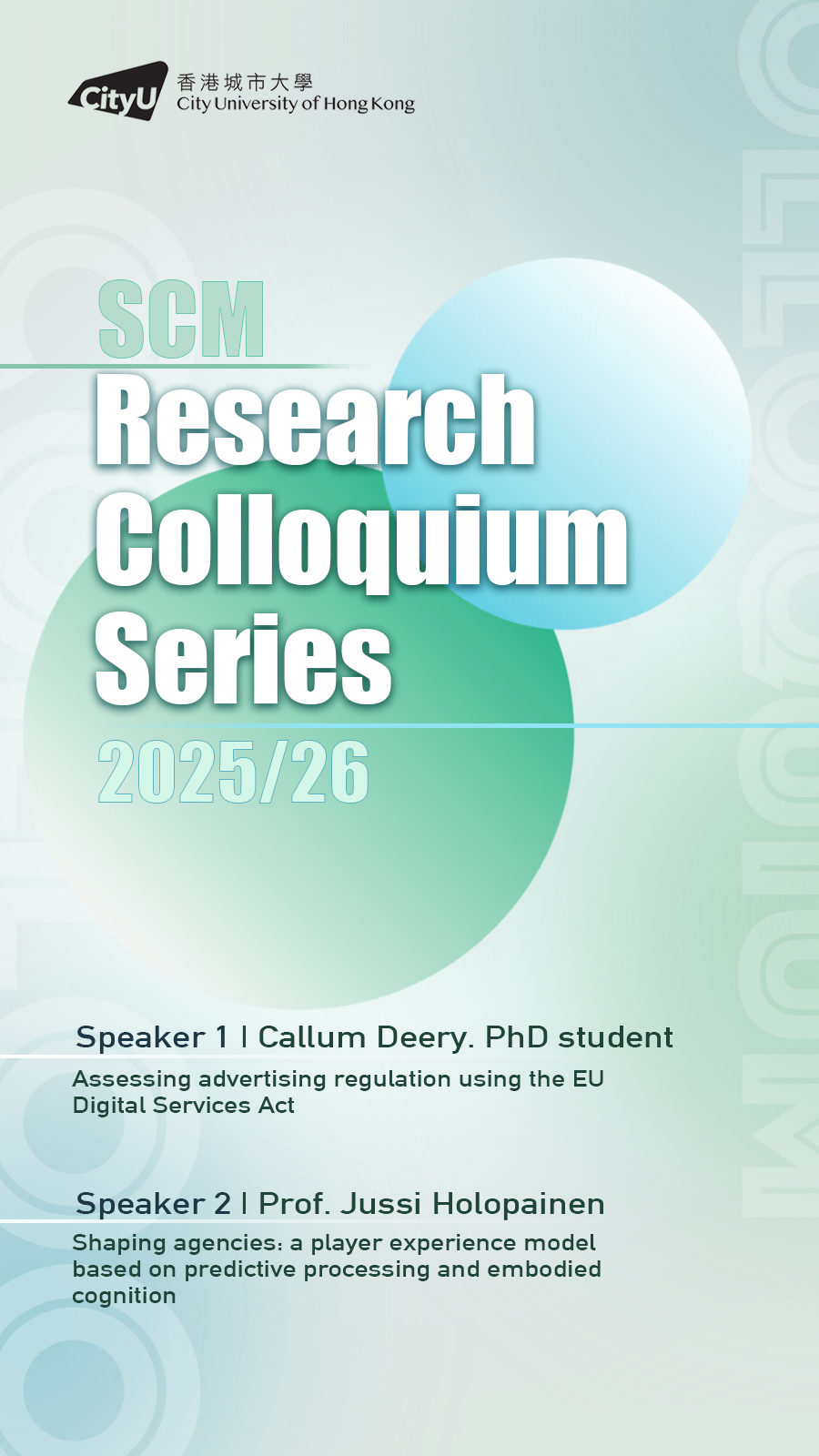
In this session, we are excited to welcome SCM PhD student, Callum Deery, and Prof. Jussi Holopainen to share their research projects.
Seminar 6
17 March 2026 (Tuesday), 3:30 pm -5:30 pm
Assessing advertising regulation using the EU Digital Services Act
Callum Deery, PhD student
Countries regulate advertising to protect consumers. The newly adopted EU Digital Services Act requires large online platforms to provide a full database of all ads shown. Some platforms like Meta also voluntarily provides these data for other non-EU jurisdictions. We used the Meta Ad Library to study video game and gambling companies' compliance with regulatory rules in the UK, South Korea, Ireland, and the Netherlands. We found widespread non-compliance in the video game context, but better compliance in the gambling context.
Shaping agencies: a player experience model based on predictive processing and embodied cognition
Prof. Jussi Holopainen
In this talk, I will outline a preliminary framework for understanding the dynamics of aesthetic experiences and conscious and unconscious processes involved in aesthetic experiences and meaning-making in games, especially current video games. Any kind of aesthetic experience builds on our human and personal engagements with the world. Thus, to understand and explain aesthetic experiences, we must comprehend how experiences, i.e., the feeling of what happens, emerge through intricate, dynamic, and highly intertwined processes that involve and require interaction with the environment. John Dewey’s pragmatist aesthetics already emphasized that art crystallizes and intensifies everyday experiences. Dewey held that in a successful art experience, “doing and undergoing” fuse into an integrated whole, guided by a unifying quality that pervades the experience. This view situates aesthetic experience in continuity with ordinary embodied experience, differing primarily in its heightened coherence and meaningfulness. Interactive digital media, and video games in particular, sharpen these questions by adding agency to the aesthetic equation. In a game, the player is not just a spectator but an active agent making choices, and those choices themselves become part of the aesthetic experience. Gameplay experiences can be understood as crystallizations or caricatures of human agency. Echoing Dewey, we can say a game distills certain intentional activities into an artful form. The proposed framework integrates these starting points with recent advances in cognitive sciences, namely predictive processing and 4E (embodied, embedded, enacted, extended) cognition. The framework allows us to shed new light and provide new insights into problems and issues related to player experience and situates games as a significant artform. We highly recommend PhD and Master's students and faculty members to join the informative and inspiring academic seminar to gain creativity and opportunities. We are looking forward to seeing you at our research colloquium.
We highly recommend PhD and Master's students and faculty members to join the informative and inspiring academic seminar to gain creativity and opportunities. We are looking forward to seeing you at our research colloquium.