

4th SCM Research Colloquium 2025/26
Seminar
The SCM Research Colloquium serves as a presentation platform for sharing and discussing recent projects within SCM, featuring presentations by researchers, faculty members, and esteemed guests. As a session open to all for ideas exchange and intellectual conversations, each session features two speakers, accompanied by engaging Q&A discussions hosted by either Prof. Espen Aarseth or Prof. Richard Allen.
10 Feb 2026
3:30 p.m. - 5:30 p.m.
M6058 Screening Room 2, Run Run Shaw Creative Media Centre
Free Admission
|
|
In this session, we are excited to welcome our PhD student, Song Zijing, and Prof. Christian Wagner to share their research projects.
Seminar 4
10 February 2026 (Tuesday), 3:30p.m-5:30 p.m
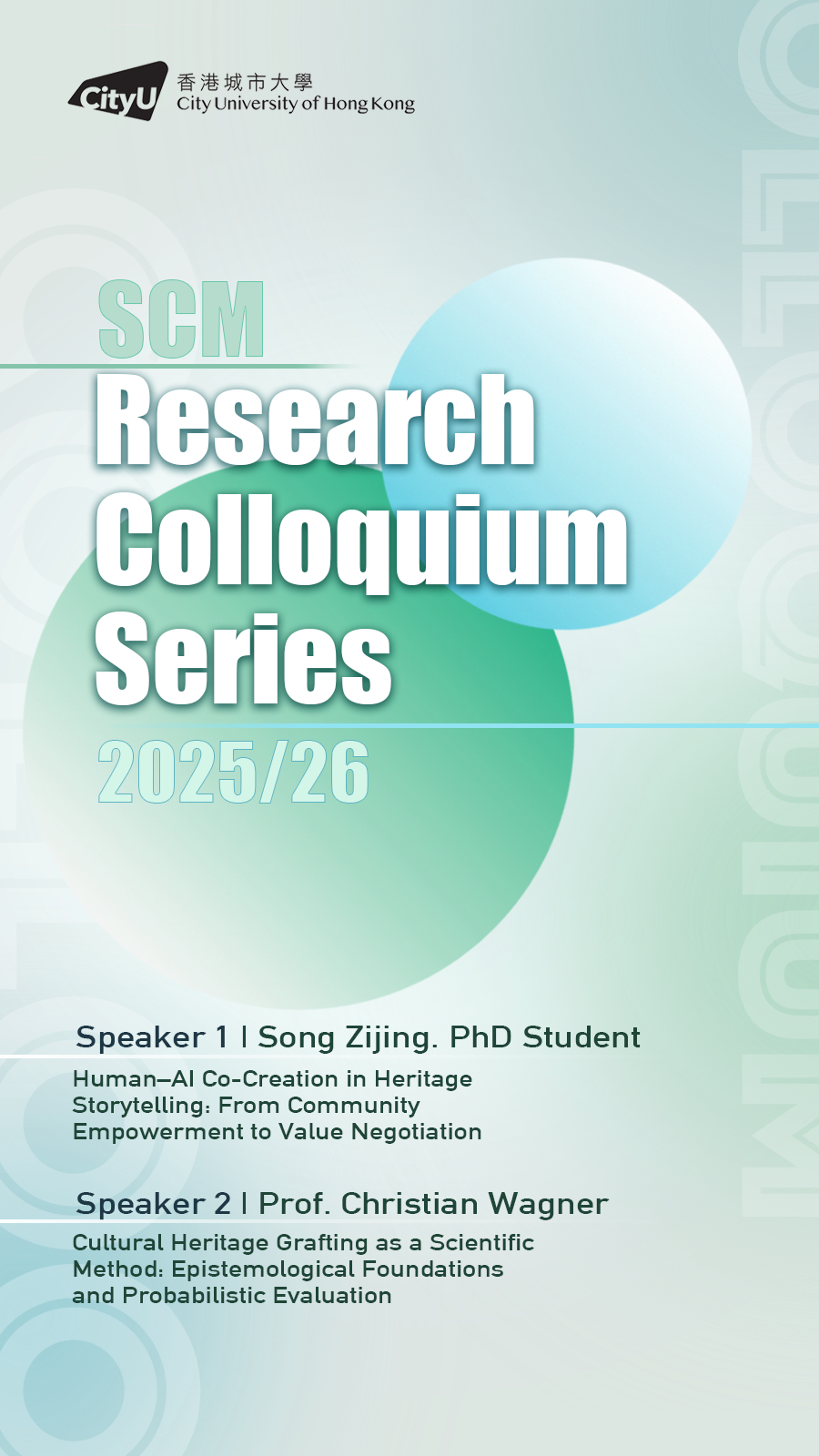
Human–AI Co-Creation in Heritage Storytelling: From Community Empowerment to Value Negotiation
Song Zijing, PhD student
This presentation examines human–AI co-creation in cultural heritage storytelling through a two-stage design research project. It addresses a long-standing question in heritage contexts: when digital tools are introduced into heritage storytelling, how is authenticity understood and evaluated by different actors?
The first stage reports a community-based design intervention conducted during a traditional Japanese festival. Local elders worked with generative AI tools to translate fragmented personal memories into visual narratives. This process enabled elders and other non-expert participants to take part in heritage storytelling and to articulate experiences that were not easily represented through existing documentation practices. At the same time, the design process foregrounded tensions concerning representational adequacy, authorship, and the alignment between generated narratives and local cultural practices.
Building on these observations, the second stage adopts an analytical perspective to examine how different stakeholder groups, including elders, younger residents, and tourists, interpret and assess heritage narratives produced through co-creative design processes. Qualitative analysis of participants’ responses shows that these assessments are shaped by distinct and sometimes competing criteria of value. Such criteria are understood and prioritized differently across stakeholder groups, resulting in divergent judgments about what makes a heritage narrative meaningful, convincing, or appropriate.
Taken together, the two studies suggest that co-creation in heritage storytelling should not be understood solely in terms of creative output or technical means. Instead, it functions as a site where cultural values are articulated, compared, and negotiated through design practice.
Cultural Heritage Grafting as a Scientific Method: Epistemological Foundations and Probabilistic Evaluation
Prof. Christian Wagner
Cultural heritage grafting (CHG) is a computational strategy for generating plausible counterfactual narratives from fragmentary sources, yet its scientific legitimacy remains contested.
This article introduces CHG and positions it as a hypothesis-driven research method grounded in abductive reasoning and probabilistic validation. After differentiating CHG from digital restoration, creative heritage remix, and simulation archaeology, we formalise its workflow: evidence encoding, generative projection, contextual authenticity checks, and Bayesian-logistic plausibility scoring. A logistic regression, calibrated on medieval chronicles, quantifies how individual narrative elements raise or lower a scenario’s latent soundness. An extended case study—the “day-in-1054” of Emperor Heinrich III—shows how reliable acts (morning prayer, Rammelsberg silver allocation) drive probability upwards while weak claims (an undocumented weavers’ revolt) undermine overall credibility. We conclude that CHG is scientifically defensible when its speculative moves remain transparent, parameter weights are published, and counterfactual pruning is reported.
We highly recommend PhD and Master's students and faculty members to join the informative and inspiring academic seminar to gain creativity and opportunities. We are looking forward to seeing you at our research colloquium.