

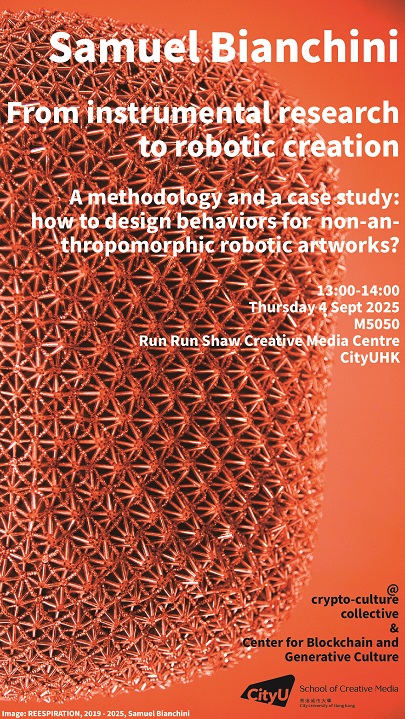
From Instrumental Research to Robotic Creation - A methodology and a case study: how to design behaviors for non-anthropomorphic robotic artworks?
Seminar
04 Sep 2025
1:00 pm - 2:00 pm
Chow Sang Sang Lecture Theatre (M5050), L5, Run Run Shaw Creative Media Centre, CityUHK
Free admission
|
|
Registration for non-CityUHK member visitors: https://forms.gle/U4pznUYekZnPGJJm7
Prior registration is required 1 day in advance.
Abstract
Today, research in art and design is flourishing. But how can such research be developed in the academic field, while guaranteeing its artistic quality and professional recognition in the world of art and design? Such research must enable the creation of relevant artworks, while at the same time producing new knowledge. Based on practice, research can be carried out through reflexivity as much as through a willingness to share, not just the results but, above all, the means brought into play: the artistic “instrumentarium” thus experimented with and developed. This research, which could be described as “organological” or even “organogenetic”, is undoubtedly one of the foundations of the research-creation carried out at EnsadLab, most often in a multidisciplinary dynamic involving both experimental and engineering sciences.
To present such a methodology, based on practice, what better way than through a case study: the “Behavioral Objects” research and creation project, conducted since 2012 at EnsadLab and from which a new book will be published at the end of the year: Behavioral Objects, Behavioral Matter - Rethinking Robotics Through Contemporary Art: An Atlas (Spector Books, Leipzig, 2025).
Since abstract robotic objects do not a priori possess expressive capabilities through their form, how can they be given a behavioral nature, or even a personality, if not through their animation, their quality of movement, which must then be studied, formalized, implemented, and experimented with using an iterative methodology that is simultaneously practical, reflexive, and multidisciplinary, combining philosophy, robotics, art, design, cognitive science, and anthropology? For the past twelve years, research and creations on such "behavioral objects" have been developed by a multidisciplinary team supported by EnsadLab's Reflective Interaction group. Initiated and coordinated by Samuel Bianchini and Emanuele Quinz, this work aims to produce reflections and theories in close dialogue with practical experiments, with implementations and public performances of such objects. Returning to practice, this same work also allows us to establish conceptual and material conditions for developing these behavioral objects. This is what Samuel Bianchini will do, based on numerous examples of artworks of this nature and workshops devoted to them.
About the Speaker
Samuel Bianchini is an artist and teacher-researcher (professor, habilitated to supervise research) at École nationale supérieure des Arts Décoratifs (EnsAD, Paris Sciences et Lettres University) where he is the head of the Reflective Interaction group of EnsadLab (EnsAD’s laboratory) on research on interactive “dispositifs”. Here, from 2017 to 2023, he was also co-head of La Chaire arts & sciences, created with École Polytechnique and the Daniel & Nina Carasso Foundation. He is a member of SACRe Laboratory (Sciences Arts Création Recherche) of PSL University and involved in its doctoral program, for which he supervises PhD in art and design. He is also member of the canadian research-creation network Hexagram and associate member of the Cluster of excellence Matters of Activity, Humboldt Universität zu Berlin.
With more than 100 collective and 20 solo exhibitions, his works are regularly presented in Europe and around the world: Centro Cultural Banco do Brasil (Belo Horizonte, Rio De Janeiro, São Paulo, Brasilia), Benaki Museum Pireos (Athens), Red Brick Museum (Beijing), Jeu de Paume (Paris), Zürcher Gallery (New York), Centre Georges Pompidou (Paris), Wood Street Galleries (Pittsburgh), Nuit Blanche (Toronto), Medialab Prado (Madrid), Palais de Tokyo (Paris), Art Basel, space_imA and Duck-Won Gallery (Seoul), Nuit Blanche (Paris), Museum of Contemporary Art Ateneo of Yucatán Museo de Arte Contemporáneo Ateneo de Yucatán (Mexico), Zentrum für Kunst und Medientechnologie (ZKM, Karlsruhe), Musée d’art moderne de la Ville de Paris, etc.
In close relation to his research and artistic practice, Samuel Bianchini has undertaken theoretical work, which has led to numerous publications. He has published over 70 texts with publishers such as Springer, Editions du Centre Pompidou, Editions Jean-Michel Place, MIT Press, Analogues, Burozoïque, Hermes, Les presses du réel, Birkhauser, Spector Books, etc. As an author, director or co-director, he edited 7 books including the collective book Practicable. From Participation to Interaction in Contemporary Art, MIT Press, 2016 (co-directed with Erik Verhagen). He also founded the international and multi-platform image-based journal .able of which he is currently editor-in-chief, a journal published by Actar (Barcelona, New York) and developed with the support of The Daniel and Nina Carasso Foundation in France and Spain. He will publish, with Emanuele Quinz, at the end of 2025, a new collective book, with Spector Books: Behavioral Objects, Behavioral Matter - Rethinking Robotics Through Contemporary Art: An Atlas.
Websites
www.ensadlab.fr
https://reflectiveinteraction.ensadlab.fr
https://able-journal.org
www.dispotheque.org
https://mitpress.mit.edu/books/behavioral-objects-i
https://mitpress.mit.edu/books/practicable