

2nd SCM Research Colloquium 2026/27
Seminar
The SCM Research Colloquium is a space to share research with the SCM community, test ideas, receive feedback, and connect with students and faculty across different areas. Held roughly once a month during term time, it brings together PhD students, faculty and guests for short research talks and informal exchange.
13 Nov 2026
4:00 pm - 6:00 pm
M7001, L7, Run Run Shaw Creative Media Centre, City University of Hong Kong
Free admission
|
|
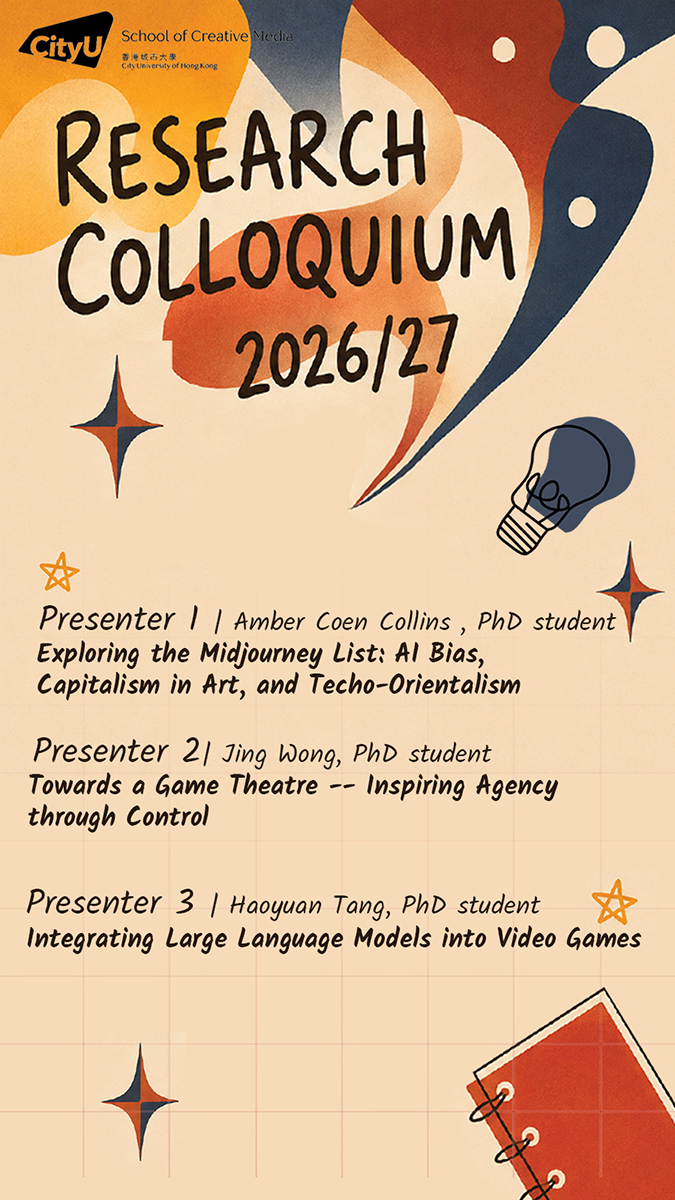
In this session, we are excited to welcome PhD students, Amber Coen Collins, Jing Wong and Haoyuan Tang to share their research projects.
Seminar 2
13 November 2026(Friday), 4:00 pm - 6:00 pm
Exploring the Midjourney List: AI Bias, Capitalism in Art, and Techo-Orientalism
Amber Coen Collins, PhD student
In 2022, a list of scraped artists was leaked to the public from generative AI company Midjourney. This list consisted of 4,700 promoted artists, alongside the aforementioned 16,000 artists identified for inclusion. It became one of the key documented sources demonstrating the scraping practices and workflows of generative image systems such as Midjourney, Stable Diffusion, and other generative companies. This talk breaks down the demographics of artists across gender, living status, and geographic dominance, as well as trends in artistic styles, mediums, and art movements. The data reveals significant biases not only in the scraping and categorisation of artists but also in the reinforcement of long-standing biases and art-historical hierarchies, both within the digital realm and across wider culture.
Towards a Game Theatre - Inspiring Agency through Control
Jing Wong, PhD student
Games and Theatre are two fields that seldom overlap in academic discussions, but existing performance formats like Immersive Theatre and immersive game formats like Murder-Mysteries have been cross-pollinating, each borrowing elements such as rules mechanics and storytelling to their disciplines. These hybrids are not purely Games nor Theatre, but something that could be broadly described as Interactive Experiences.
When one participant engages in an Interactive Experience, major themes that emerge are Control and Agency. How much does the production control the experience and how does that affect the participant’s freedom to act? In this thesis I will explain how ‘Control’ could be framed under Games and Fiction as Rules and Narrative Frames. I aim to prove through my thesis that Little Rules inspire Action whilst too many rules lead to Inaction. More Narrative Frames on the other hand, limits Action and inspires Contemplation.
Integrating Large Language Models into Video Games
Haoyuan Tang, visiting PhD student
Despite expectations that large language models would transform games through responsive NPCs and open-ended worlds, their impact remains more evident in asset production than gameplay. This talk asks how LLMs might be integrated with conventional gameplay, where players act through movement, exploration, combat, and collection rather than language alone. Drawing on Façade and Event[0], it examines how intermediate layers interpret player activity and game state to produce responses suited to unfolding situations. It argues that LLMs may neither replace conventional gameplay nor bring an immediate revolution, but could extend established genres or enable new forms of play as game-native systems.
We’re delighted to invite you to the second SCM Research Colloquium of 2026/27, now in a new space and a more social Friday-afternoon format. Please join us on 13 November for three short research talks, followed by conversation over light refreshments and drinks.