

1st SCM Research Colloquium 2026/27
Seminar
The SCM Research Colloquium is a space to share research with the SCM community, test ideas, receive feedback, and connect with students and faculty across different areas. Held roughly once a month during term time, it brings together PhD students, faculty and guests for short research talks and informal exchange.
09 Oct 2026
4:00 pm - 6:00 pm
M7001, L7, Run Run Shaw Creative Media Centre
Free admission
|
|
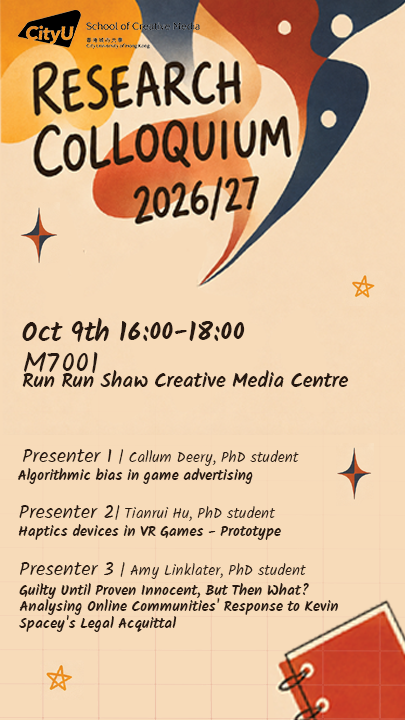
In this session, we are excited to welcome PhD students, Callum Deery, Tianrui Hu and Amy Linklater to share their research projects.
Seminar 1
9 October 2026(Friday), 4:00 pm - 6:00 pm
Algorithmic Bias in Game Advertising
Callum Deery, PhD student
This study explores algorithmic bias in game advertising on Meta's platforms (Facebook, Instagram), demonstrating the strong gender bias present in advert delivery and the stereotypes about gaming that the algorithm reflects. The talk aims to introduce the study of algorithmic bias, how it can be measured and assessed both within games and other fields. Finally it aims to discuss the implications of promotion algorithms on game development, how they may disadvantage genres and contribute to defining what is considered a game and who gets to be a "gamer".
Haptics devices in VR Games - Prototype
Tianrui Hu, PhD student
Extensive research has explored haptic rendering of surface textures in virtual reality (VR). However, it is still challenging to provide realistic texture-based haptic feedback that aligns with users’ fingertip motion in VR. We present OmniTex, a handheld haptic device that enables continuous omnidirectional texture rendering in VR. OmniTex integrates a 2 DoF rotational mechanism to support fingertip-aligned motion and deliver directional shear feedback, together with a linear translation mechanism for dynamic texture switching. Technical evaluation revealed low latency averaging around 250ms with our system for texture switching and motion synchronization. Our user studies further demonstrated the effectiveness of our design in improving user-perceived visual–tactile congruence in VR with different finger movements and different types of virtual textures, and our system offered significantly better sense of realism in VR compared with controller-based vibration, achieving performance comparable to that of real-surface proxy interaction.
Guilty Until Proven Innocent, But Then What? Analysing Online Communities' Response to Kevin Spacey's Legal Acquittal
Amy Linklater, visiting PhD student
‘Innocent until proven guilty’ can appear reversed in the digital age of ‘cancel culture’, where public figures may be widely condemned before legal guilt has been established. But what happens when someone previously treated as guilty is subsequently found ‘not guilty’? In 2017, amid the momentum of the #MeToo movement, Kevin Spacey was publicly condemned and professionally excluded following allegations of serious sexual misconduct, before being acquitted of criminal charges in 2023. His acquittal therefore raises questions about how established moral judgements are negotiated following legal acquittal.
This paper examines responses within Reddit communities to Spacey’s acquittal, focusing on how users justified their moral evaluations of him and the rhetorical strategies through which these positions were defended, challenged, and sustained. Using Qualitative Content Analysis (QCA) and Critical Discursive Psychology (CDP), the findings show that, while the acquittal formally resolved the criminal charges, it did not resolve Spacey’s moral or reputational status. Instead, the verdict became a discursive resource through which users actively negotiated its meaning and implications for his culpability, reputation, and prospects for professional rehabilitation. Ultimately, the findings highlight the limits of legal judgement in reshaping established moral perceptions, demonstrating how acquittal can reignite, rather than resolve, moral contestation, especially within digital spaces.
We’re delighted to invite you to the first SCM Research Colloquium of 2026/27, now in a new space and a more social Friday-afternoon format. Please join us on 9 October for three short research talks, followed by conversation over light refreshments and drinks.