

7th SCM Research Colloquium 2025/26
Seminar
The SCM Research Colloquium serves as a presentation platform for sharing and discussing recent projects within SCM, featuring presentations by researchers, faculty members, and esteemed guests. As a session open to all for ideas exchange and intellectual conversations, each session features two speakers, accompanied by engaging Q&A discussions hosted by either Prof. Espen Aarseth or Prof. Richard Allen.
31 Mar 2026
3:30 pm - 5:30 pm
Screening Room 2 (M6058), Run Run Shaw Creative Media Centre
Free Admission
|
|
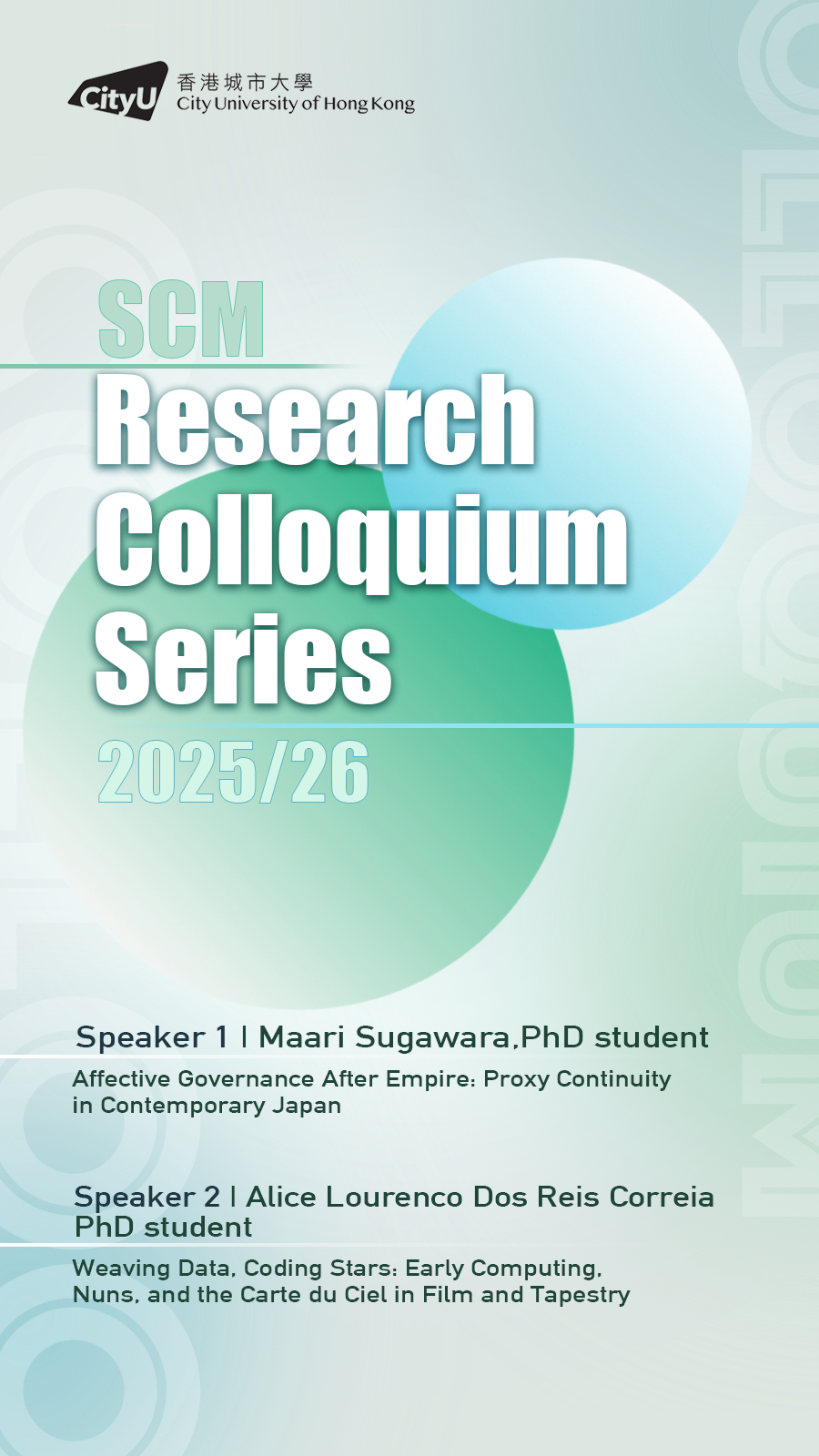
In this session, we are excited to welcome SCM PhD students, Maari Sugawara and Alice Lourenco Dos Reis Correia to share their research projects.
Seminar 7
31 March 2026 (Tuesday), 3:30 pm - 5:30 pm
Affective Governance After Empire: Proxy Continuity in Contemporary Japan
Maari Sugawara, PhD student
This presentation introduces my dissertation, which examines how post-1945 Japanese governance renders “continuity” administrable across culture, gender, care, and techno-futurity. In Japan, continuity names the institutional problem of sustaining national endurance and social reproduction under low fertility, rapid population aging, economic contraction, and geopolitical strain. This pressure shifts continuity beyond biological reproduction toward procedural and infrastructural substitutes—data, images, and roles that can be duplicated, rented, or replayed. I call this formation proxy continuity, a governance logic that secures endurance through stand-ins by rendering personhood legible as extractable traces (face, voice, gesture, affect) and redistributing obligation across institutions, platforms, and contracts.
Methodologically, the project combines analysis of policy and platform governance materials with media analysis, interviews, and arts-based research. It tracks proxy continuity across three sites that instantiate the same logic in distinct registers. First, Japan’s Moonshot Research and Development Program (2019–2050), especially its “Cybernetic Avatar” agenda, reframes demographic crisis as a post-biological design mandate, proposing multiplied presence “beyond body, brain, space and time,” including posthumous persistence, as an infrastructural response to demographic and labour constraints. Second, non-consensual deepfake pornography in Japan foregrounds proxy continuity’s gendered underside. Women’s and minors’ images are rendered reproducible sexual proxies, extending patriarchal violence, while legal lacunae and complaint-driven procedures disperse accountability across jurisdictions and intermediaries. Third, Japan’s rental family industry stages proxy continuity at the level of intimacy. Drawing on ethnographic research with rental mothers and practice-based inquiry, I analyse outsourced care and contractual kinship as techniques that both stabilise and unsettle gendered obligation and normative family structure.
Weaving Data, Coding Stars: Early Computing, Nuns, and the Carte du Ciel in Film and Tapestry
Alice Lourenco Dos Reis Correia, PhD student
This talk presents two interconnected art projects developed in 2025—a 16mm film and a series of tapestries—that investigate histories of early computation and its ties to weaving and gendered labor. Both works center on the late 19th "Carte du Ciel" project, an ambitious international initiative to map the entire night sky. This endeavor relied on a labor force of human "computers," often women, who performed the tedious calculations necessary to translate photographic plates into stellar coordinates. Specifically, these works are inspired by the four nuns at the Vatican Observatory who, as part of this project, mapped more than 40,000 stars.
The presentation will use these art works to explore the convergence of gendered manual craft and computation. The film, Oh Be a Fine Girl Kiss Me, uses the speculative memoir of a soul to weave together the story of a nun-computer at the Vatican Observatory and the promise of a new life as a coder in 1990s Portugal. It meditates on questions of personal agency versus machinic performance in the context of computation, astronomy, and image capture histories. Complementing the film, the tapestry series will be discussed as a conceptual and material parallel. Working as an intuitive mirror to the film, the tapestries draw a direct line between the gendered labor of textile production and the tedious, repetitive work of early women "computers," while also drawing a parallel between the binary logic of the loom (warp and weft) and the 0 and 1 of computational code.
We highly recommend PhD and Master's students and faculty members to join the informative and inspiring academic seminar to gain creativity and opportunities. We are looking forward to seeing you at our research colloquium.