

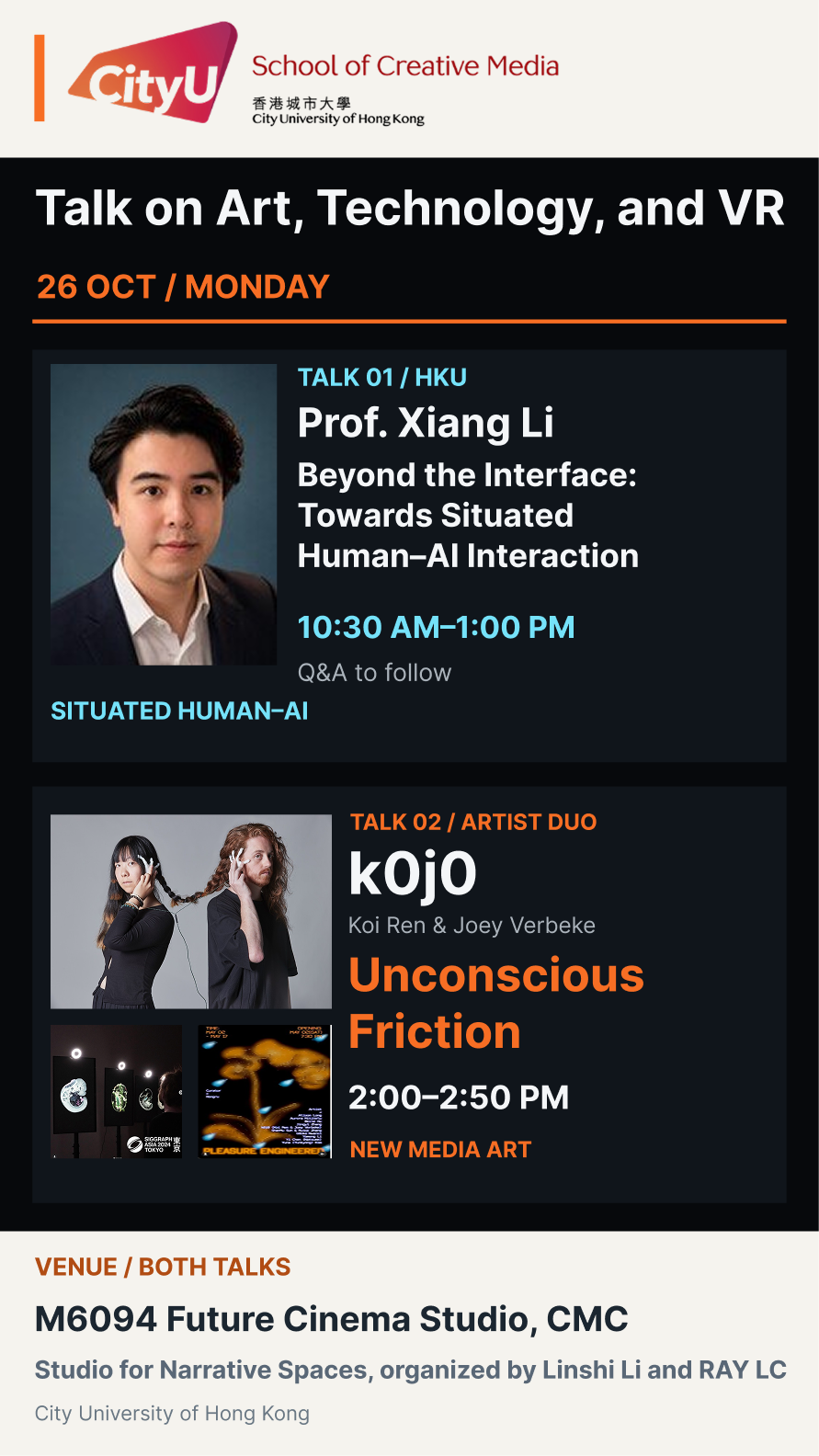
Beyond the Interface: Towards Situated Human–AI Interaction | Unconscious Friction
Seminar
26 Oct 2026
10:30 am - 1:00 pm; 2:00 pm - 2:50 pm
Future Cinema Studio (M6094), L6, Run Run Shaw Creative Media Centre, City University of Hong Kong.
Free admission
|
|
10:30 am - 1:00 pm
Beyond the Interface: Towards Situated Human–AI Interaction
Abstract
As computing moves beyond conventional screens and becomes embedded in our bodies, physical environments, and everyday activities, interaction increasingly depends on the situation in which it takes place. Yet many interactive systems remain largely detached from this situated context, treating the body, surrounding space, ongoing activity, and user intent as separate or implicit elements of interaction.
This talk examines a progression toward situated human–AI interaction, beginning with body-centric interaction and extending toward spatially and contextually aware intelligent systems. A series of projects explores how the human body can serve not only as an input mechanism, but also as a persistent spatial reference for interaction, information access, and interface organization. This perspective is subsequently extended into the surrounding environment, where interfaces and interaction techniques are designed around relationships among the user, virtual content, physical space, and ongoing activity.
These investigations motivate a broader shift from designing individual interaction techniques toward building systems that can understand and adapt to the situations in which interaction occurs. Recent work at the Situated Reality Lab explores this direction through context-aware and proactive AI, adaptive spatial interfaces, multimodal interaction, and situated agents. Together, this research advances a vision of interactive intelligence that is grounded in the body, space, and context, enabling computing to become a more integrated extension of human perception, action, and capability.
About the Speaker
Professor Xiang Li is an Assistant Professor in Human-Computer Interaction and Extended Reality in the Department of Data and Systems Engineering (DASE) at The University of Hong Kong (HKU), where he directs the Situated Reality Lab (SiR@HKU). He received his PhD in Engineering from the University of Cambridge and was a Student Fellow at the Leverhulme Centre for the Future of Intelligence (LCFI). Prior to joining HKU, he was a Research Scientist Intern at Sony Computer Science Laboratories (Sony CSL) Kyoto and a Guest Researcher at The University of Tokyo. He also held visiting research positions at the Hong Kong University of Science and Technology (Guangzhou), Institut Polytechnique de Paris (Télécom Paris), Carnegie Mellon University, and Monash University. He received his B.Sc. (Honours) from Xi’an Jiaotong-Liverpool University and the University of Liverpool in Information and Computing Science.
His research lies at the intersection of Human–AI Interaction, Extended Reality, and Human–Computer Interaction, with a particular focus on context-aware and proactive AI, intelligent spatial interfaces, human augmentation, and situated interaction. His broader research agenda investigates how interactive and intelligent systems can move beyond standalone tools toward situated extensions of human perception, action, and capability.
His research has appeared in leading HCI and XR venues, including ACM Conference on Human Factors in Computing Systems (ACM CHI), ACM Transactions on Computer-Human Interaction (ACM TOCHI), ACM Symposium on Spatial User Interaction (ACM SUI), IEEE Transactions on Visualization and Computer Graphics (IEEE TVCG), IEEE Conference on Virtual Reality and 3D User Interfaces (IEEE VR), and IEEE International Symposium on Mixed and Augmented Reality (IEEE ISMAR), and has received multiple recognitions, including the 2025 UKRI Innovate UK Immersive Tech Award for Technical Innovation, a 2025 IEEE ISMAR Best Paper Honourable Mention, the 2023 ACM CHI PLAY Best Interactivity Audience Award, and a 2020 IEEE VR Best Conference Paper Nomination. In 2025, he was selected as the University of Cambridge delegate to the Stockholm International Youth Science Seminar (SIYSS 2025), held during Nobel Week.
2:00 pm - 2:50 pm
Unconscious Friction
Abstract
Seamless interfaces promise to remove friction, but what tensions do they conceal, and whose interests does their smoothness serve? This talk explores friction and unconscious friction at the intersection of perception, agency, and technological mediation, examining how interfaces and the systems behind them shape thought and behavior beneath conscious awareness. It considers friction both as a condition to investigate and as an artistic method for making hidden dynamics felt. Drawing on k0j0's research and interactive works, the discussion connects the politics of interface design with the practice of creating within these same systems, asking how critical encounters can unsettle technological futures presented as inevitable.
About the Speaker
k0j0 expose the unconscious friction within phantasmagoric systems.
k0j0 (Koi Ren and Joey Verbeke) is a new media art duo creating subversive and frictional 'intrafaces , artifacts that reveal the power, politics, and posthuman subjectivities embedded within systemic interactions. Their research-based practice pulls from backgrounds in human-computer interaction, artificial intelligence, media studies, and speculative design.
Through the defamiliarization of seductive seamlessness and tacit expectations, k0j0 provokes moments of epistemological rupture, inviting viewers into intimate proximity with the unfamiliar and the emergent dynamics shaping our futures.
Selected exhibitions include Ars Electronica, SIGGRAPH, Asia Culture Center, MUTEK, Gray Area, and the Sundance Film Festival.
Talks facilitated by Studio for Narrative Spaces and organised by Linshi Li and RAY LC